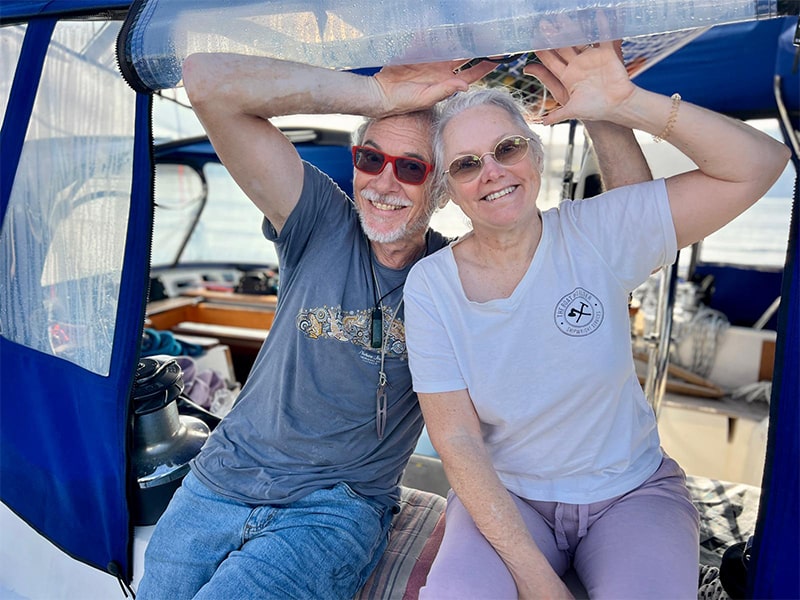
My recollections of our NZ Fiji crossing is a messy haze of days, moments and sensations. The latter was predominately seasickness. Amongst my haze awash with nausea there were magic moments that lifted my spirit and gave me joy when reflecting on our voyage.
Having attempted two crossings previously…
The first was our voyage from Australia to NZ. The other was an aborted voyage from NZ to Vanuatu; we had to turn back when Martin fell ill. And so, you see that I have had little experience to base my expectations on.
On our Australia / NZ crossing I was seasick for two days, though that didn’t hinder me in my responsibilities and watches that I loved. Perhaps with our first crossing, my eyes were big and my mind in awe as everything was new. One big unknown for both Marty and I was how would we feel when we could no longer see land. We found that we both loved it. I was in awe and in tune with my surroundings, with nature and had a deepness of joy of being at one with the natural universe. This joy was further deepened by undertaking the crossing with two of my favourite people, my husband and my brother-in-law.
Our crossing was gentle. Mother nature was kind to us. I had fallen in love with night sailing, the stars and the moon on the water. I recall conversing with my (experienced seaman) uncle, saying ‘I don’t know whether to be disappointed or relieved’. To which he replied, ‘Be relieved, as there will be days when you will wish mother nature would have been kinder to you.’ As they say, you plan for the worst and hope for the best.
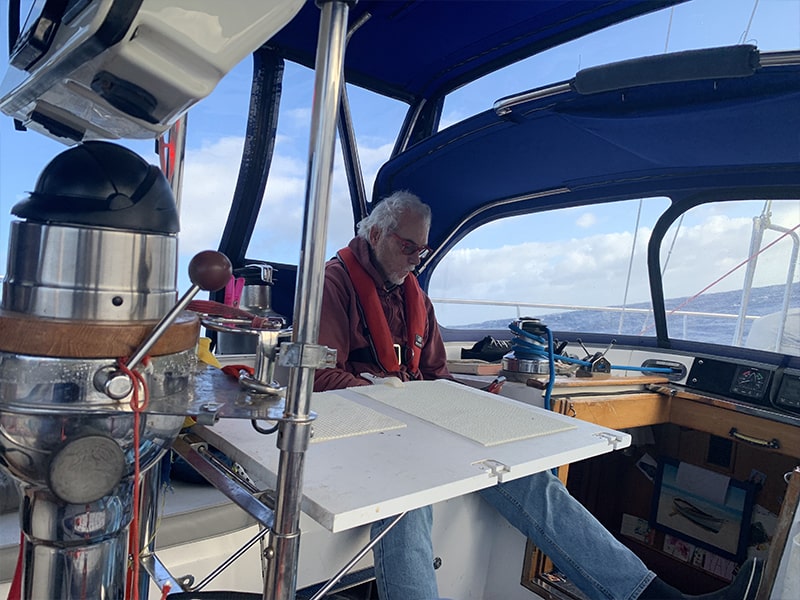
I found that on this NZ Fiji crossing that I missed the clarity of our second (aborted Vanuatu) ocean trip. I can’t recall a time in the last 10 years or so where I had been clearer in my head as then. No nagging inner voices, no pressure of things to do, totally in the moment and present.
Perhaps for the Vanuatu voyage I had a different mix of the excitement and anticipation nerves. Less concern and more eagerness. It became clear fairly quickly that I was not going to experience the seasickness of my first trip. It turned out it was Marty’s (aka hubby) turn. This trip, I did not have concerns about how I would feel being out of sight of land. I had no concerns about how our boat Saboteur would handle the seas. I trusted her completely. Despite having to turn back after 3.5 days I look back on this voyage as a challenge I stepped up to. I loved this voyage for other reasons. However, we did not achieve our dream to sail to Vanuatu.
With the above context for our NZ Fiji crossing, despite the rise and fall of the sun, the days were a haze for me. My disappointment is that I had hoped to write lyrically about a magical voyage took you the reader with me on our adventure. Finally, I write to share our tales, but I warn you they were without the rose-coloured lens of hopes and dreams, but the reality of day-to-day passage making and its challenges.
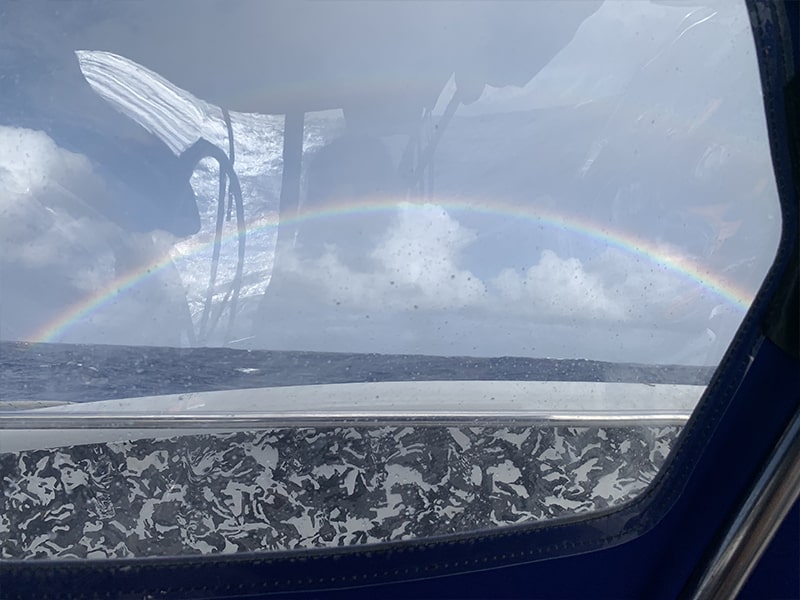
Meet our crew
We cleared customs late afternoon and returned to our boat. Before casting off out of the beautiful Bay of Islands Marina Opua, I poured 5 glasses of Sailor Jerry, a spiced Jamaican rum. One for each of the crew and one for the weather gods asking them to be kind to us. And so, we departed in a wave of excitement and energy. It was Skipper Marty (Hubby), First-mate Tess, Able-crew man Iain and Able-crew man Michael. As with any new crew you never really know how they are going to handle a passage and fit in. What starts well with best intentions does not always work out that way. We have heard horror stories. Fortunately, our crew were brilliant.
Meet Iain
Marty had meet Iain in Gisborne, a picturesque small town on the east coast of NZ located in Poverty Bay. The bay is a mixture of rugged coastline and sandy surf beaches that stretch further than the eye can see, divided by a large river mouth where three rivers meet and run out to sea. The area is famous for its wines, farming, timber, fruit and vegetables. For us, it’s amazing friendliness.
The town has character. It is a small harbour centre with enough of the “essential Kiwi experience to bring the large tourist ships into port.
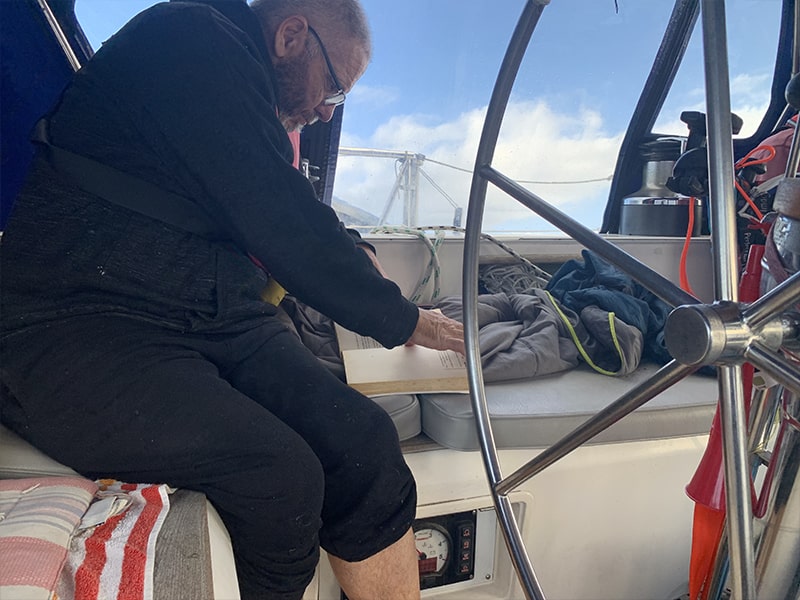
We met Iain in Gisborne. He is/was a tuna fisherman. The meeting was not easy as he is shy, often preferring days at sea over the company of fellow man. Marty had seen his lovely yacht in the marina and was insistent on meeting this guy. Iain had recently bought his yacht and was keen to sail. A true seaman, clearly not being at sea day-in-day-out fishing was not enough for him.
Over time their friendship developed. Marty had to sail our yacht back to Auckland and needed crew (I was still returning from being overseas). So, he asked Iain to crew for him. Marty and Iain had their first passage together. What was meant to be a 3.5-day sail, due to some damage and the inability to drop the headsail in strong following winds which meant much of the trip at speeds well over the boat’s design, saw the voyage being a 2.5-day passage. Iain unphased by unexpected damage and rough weather proved to be a practical and calm person to have on board.
I first meet Iain when they arrived in Auckland. He was grinning from ear-to-ear, in his element, jumping in and being practical. Seeing things that needed to be done and just doing them, tidying up lines, asking for tools we did not have to repair netting and finding other ways to do it anyway. He helped bring down the damaged sail and take it to land.
Meet Michael
I first met Michael when working at Burnsco Chandlery, Gulf Harbour. Michael was working for Weber marine would come into work, rummage through the plumbing wall and assemble incredible structures of plumbing fittings and walk out leaving behind a masterpiece. I knew not to disassemble it as he would typically return a couple of hours later having revised the design or obtained new measurements to ensure his masterpiece fitted into the boat they were building.
Michael is also shy and over time, we became friends. Eventually, he started accepting our invitations to dinner. About six month before our passage, he asked if we were planning to do an ocean crossing. We told him of our plans and he asked, if he could make it work (schedule wise) would he be able to crew? The answer was yes.
Timing wise, it all came together, and we rounded up our crew. Marty and I extraverts and Iain and Michael quiet introverts. We considered both to be friends. Would this be the same after 8 or 9 days at sea? Only time had that answer.
Sleeping arrangements
Our sleeping arrangements were such that, I slept in our bed. I have this amazing ability to assume the crime scene position and not move. Image the outline of a dead body on the bed. Face down sleeping with arms and legs at strange angles that means I do not roll off the bed. Our bed is an island bed which means it does not have the expected lee cloths that prevent you from rolling out when the boat either leans too far or surfs down waves.
The third night I slept in the cockpit as I was not sure if I went downstairs, I would come back up again. The last two nights under passage I also slept in the cockpit. I love sleeping there enjoying the warmer weather. Especially when we are anchored up in a calm bay with a beautiful full moon. It is pure magic. Unfortunately, I missed the beauty of the moon when we had it as I was too sick. I digress…
The boys had options where to sleep. They had a choice of the front bunk, the sea berth in the salon and the bench seat at the table and finally the cockpit. Each of these have their pros and cons.
Given the easterly nature of our winds, the ideal bunk was the sea berth in the salon. The lie of the vessel with the easterlies kept you in bed. Having said that, lee clothes are recommended as Marty found out when we bounced off a wave and he was lifted out of the bunk on to the floor. Fortunately, no injuries sustained.
The front bunk complete with a lee cloth was more like a hammock as due to the angle of the vessel. It required trust in the lee cloth and the fastening mechanisms that held it in place. This became Michaels preferred spot for sleeping.
The dining table bench seat. While on the high side of the vessel the table kept you in place easily. Iain was often found here or in the sea berth.
Getting to know each other
There were four of us living in close quarters, taking it in turns to be on watch, relax and sleep we successfully navigate this micro-environment, all of us being able to find space for ourselves and each other as required.
Our collective energies were high. Marty and I happy to be finally heading off and Iain and Michael about to undertake their dream of doing an ocean crossing. Already we all were seeming to interact together well. Marty made dinner of burgers, and we all bantered away in the cockpit. Topics ranging from boat things to life stories to fishing to building tiny houses. Why tiny houses? Random, I know. Michael has been building tiny house since 2016. He loves building. He bought his first boat at 9 years old, did it up and sold it at 11years of age. His has a small building crew dedicated to his tiny house builds. I have been helping him with his on-line web content. I had thought during the passage we would be able to discuss some work. Ha, ha – not to be.
Deciding on helm watches
One of the biggest topics that needs to be sorted out before the voyage are watches. By watches, we mean how long will each person be at the helm in charge of the boat watching for traffic, trimming sails, checking instruments, keeping an eye for damage on lines etc. Even though you are in the open ocean there is surprisingly plenty to do and look out for. And there is also a lot of nothing.
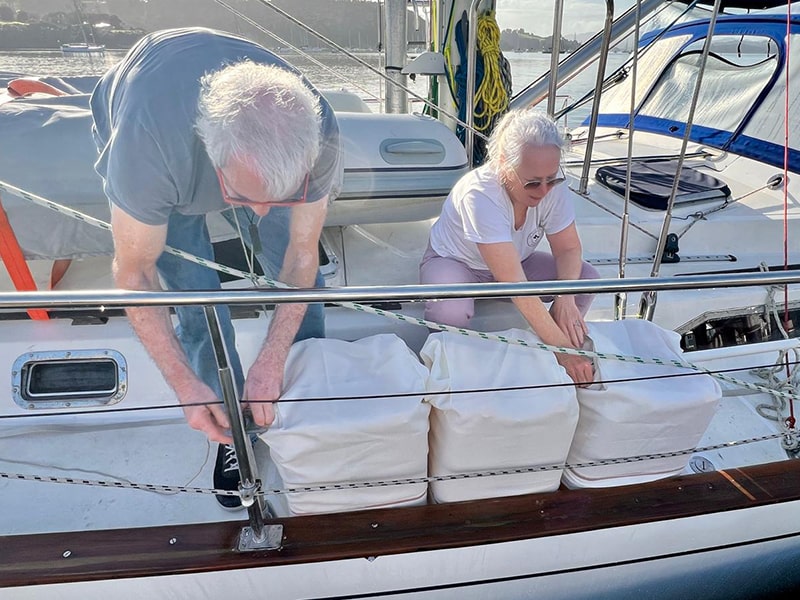
Initially Marty and I were thinking 3 hour watches twice a day. Iain threw into the mix 6-hour watches. My first thoughts were no way. However, as Iain explained we have 6 hours and the rest of the day off. Everyone appeared to be willing to try it and if it did not work and we were too tired towards the end of our watch we would switch to 3-hour shifts. And so, we started our 6-hour shifts. Marty was 6pm to midnight, Iain midnight to 6am, me 6 am to midday and Michael midday to 6pm.
Best intentions
At some time the first evening, I went to bed with the plan to get a good night’s sleep ready for my first shift at 6am. As the night went on, I could feel myself getting seasick. I hoped that the sensation would pass. Unfortunately, sometime during the night I woke to rush to the bathroom to throw up and returned to bed, only to doze and repeat. At about 7.30am Marty woke me, informing me that Iain had already done an extra 1.5hr because I and slept in. I apologised and told Marty I could not take the helm I was too sick. For the next 2 days the three boys covered my watches between them.
The third day, I did venture into the cockpit, looking green, I am sure. Suggestions were offered as to what to try and eat. Michael gave me an ‘Up and Go’ drink. Vanilla, icy cold, nice. I cautiously sipped, liked the coolness of it and took a second sip. Instantly reaching for the bowl as my body rejected the Up and Go. I don’t know if I will ever be able to drink them again. Fortunately, I was able to keep down hydrolyte drinks.
Over day 3, 4 and 5 I was regularly saying I can’t do this again. At one point I recall saying I would do the passage back to NZ and then I am done. The boys kept joking with me, especially as I regained my capacity to retain food, if I was still done. It was a resounding yes. Although I recall similar thoughts from our trip to Tin Can Bay. An eleven hour journey is very different to our 9 day NZ Fiji crossing.
We have no water
My only other recollection of the first few days was hearing a discussion that we had no water. It was impossible that we had no water as we had filled the tanks before departure the day before. Michael, the plumbing genius, set about finding the issue. He spent about 4-5 hours lifting floorboards checking each part of our water system until he found the issue. Fortunately, it was a simple fix and water once again flowed freely through our pipes. How he did that in reasonable rough seas and not be seasick I had no idea. Cast iron stomach comes to mind.
By the time I made it upstairs, the first few days of rough weather was behind us and we were heading into a couple of calm days. While this made me feel better it was not ideal for passage making. We turned the motor on and motor-sailed until here was no longer enough wind. We dropped the sails and simply motored.
Hooked on fishing
Iain with a grin on his face, threw two fishing lines out and later that day we had a skippy tuna. He killed it and blooded it and hung it on the transom to firm up a little. He than filleted it. Iain had told us that he did not know how to cook… followed by the only thing he can cook is fish. We already knew he would not be in the galley much. Still, he cooked the tuna that night in butter and garlic. We had tuna for 4 meals straight. It was wonderful.
Michael also said he was not much of a chef. However, he frequently made lunches or tea/coffee for everyone. He was the most effective person in the galley when the Saboteur was on extreme lean. Most of the evening meals fell on Marty. I truly appreciated everyone’s contributions.
The quieter days
At some point in our quiet days, we had a drink. I had Sailor Girl Jerry with orange juice, Marty had cider, Michael had Rum and Coke and I think Iain also had a Rum and Coke. I gave a rum to the weather gods. Although I am not sure they liked my choice. We don’t run a dry boat, however most of the time we do not feel like a drink. On our first passage, the calmness allowed as to have a drink with our evening meal. We would only have one. Fortunately, we have never had to say to anyone on passage, don’t you think you have had enough.
Passage maintenance
At different times, we had to attended to items out of the cockpit. These included, securing my standup paddle board or kayak and tidy up lines that were tied off at the mast that had been slowly worked their way towards the deck. In most cases, Iain proactively set about doing this informing one of us he was stepping out of the cockpit (to keep a watch on him), clipping on and getting on with what needed to be done. His years on tuna fishing boats and experience of rough seas, is forever appreciated. As is still having my SUP onboard to enjoy.
Weather monitoring
Weather wise we managed to find our way safely through three low pressure systems. Marty, Iain and Michael consulted a lot about the weather. Iain being the tuna fisherman was checking 2 hourly weather updates, while we being the cruisers were getting twice daily updates. It was great to hear them collectively explore and discuss options. As I had missed the first three days weather discussions and the next two days were calm, I saw no real need to join these conversations.
Weather planning is part science, part art all offered up to the hands of Mother Nature. All forecasting models can only give reasonable accuracy for the first 3 days. After that, it is based on the assumptions made and probability. All of the weather forecasting models said the last two days would be rough. How rough was yet to be seen. Ranges from 15knots to 30knots with gusts of 45knots. The sea forecast was between 2.5m to 4 -5 metre swells with about 7 – 9 second intervals.
The weather predictions were correct
As we journeyed north, we could see the predictions were correct. It was going to be rough. The first 4 days of sailing our sails were reefed down. For my non-sailor friends, this means we have only released enough sail for the weather conditions. Light winds normally mean full sail. Rough winds would mean reduced sail. We have three sails and a 23m mast. So, there is a lot of fabric up there to handle if the winds change quickly. At night we always reefed down so that it is easier to handle. As a result, we lose a couple of knots in speed overnight but have more manageable amounts of fabric and reduced risk of damaging the rigging.
Once again, we were sailing with reefed sails. Why? because the winds were strong and getting stronger. The seas were big and getting bigger. The first 24 hours of this rougher weather were comfortable. Comfortable is relative. We were travelling anywhere between 7 and 17degrees angle to the boat due to the easterly winds on our beam. The ocean swells gradually shifted from the south to the east. Consequently, we were not only on an angle but rising and falling between 2.5 to 3.5 metres every 8 seconds. This was comfortable because it was consistent and gentle. Our boat rose beautifully up the swell and regularly surfed down the swell.
A rough ride
Gradually the winds raised forcing our toe rails (where the boat hull meets the deck) into the water on a more regular basis. The swell grew from rolling to a sea of white caps and to breaking waves across the beam at 4 to 5 metres. The winds were consistently higher than forecast at between 30 to 40knots with stronger gusts. At one point we briefly considered changing direction and sailing in more comfortable direction to Vanuatu.
However, our destination was Fiji and our only choice was to weather out the stronger seas. At no point did Saboteur show any sign of faltering. Nor her crew. By this stage captain Marty had made standing orders that we must have two in the cockpit at all times with safety lines attached. One person on watch and someone else who can be immediately available to assist. Both our crew were loving the voyage and this weather did nothing to dampen their experience. If anything, it fuelled it. Their conversation turned to crewing for us when we sail back from Vanuatu. For us they are more than welcome.
Amazed and a little jealous
While the seas are getting rougher, I was amazed at Marty’s continued ability to read books on his iPhone. Iain’s ability to read paperback books in the cabin and Michael’s ability to jump online and order materials for his next tiny house build and check in with his crew. Meanwhile, I am unable to do any of this.
I have never been able to read on passage. The very act of writing up the logbook at the end of shift is enough to make me nauseous again and marking our position on the chart in a moving sea when nauseous is beyond me. In some ways, I feel this keeps me more connected to nature because I do not escape into a book. That is not in any way a judgement of others, when they are off watch they can do what they want. I am at the same time jealous of their ability to do so. At times I feel robbed of reading, writing or drawing time. Past passages I have made short videos and provided updates, this passage it was beyond me.
Human connection and spirit
Back to the rough seas. We had started receiving messages from other vessels ahead and behind us. A conversation in passing, only we were between 2 to 20 nautical miles from each other. They were out of sight of us bar for the AIS technology showing each other our positions. We updated each other of the sea conditions where we were. We learnt of sail damage on one boat. However, somehow these conversations were about the human connection and spirit. We all know we were close to our destination and looking out for each other. A beautiful part of human nature that one cannot explain. When we finally felt shelter of the east coast of Fiji, we radioed through to SV Blue Horizon to share the news that there is shelter ahead. Even though they knew it they were glad to hear it.
As we were getting close to the reef passage for the final leg of our voyage, we turned into the wind to lower our sails and hoist our yellow quarantine flag. SV Moin radioed us to tell us we were turning too early and heading for a reef. They had not realised we were lowering the sails. They also informed us of the style of channel markers, how to line them up and gave us the precise bearings for our approach once in the channel. The angle was 78 degrees, just in case you wanted to know. Amongst all those pieces of information I forget to tell them we were only lowering our sails. They probably still think we are novices. Which we are in many ways.
Almost there
Michael had handed over the helm to Marty at 6, and a couple of hours later he was fatigued. It was a seriously rough watch. He went and had a power nap returning to the cockpit around 5 hours later refreshed.
Back in the cockpit we were all in good spirits. All on look out as there are reefs everywhere and we were arriving at night. We turned into the passage around 9pm and had another 17 nautical miles to go to where we could anchor for the night. .
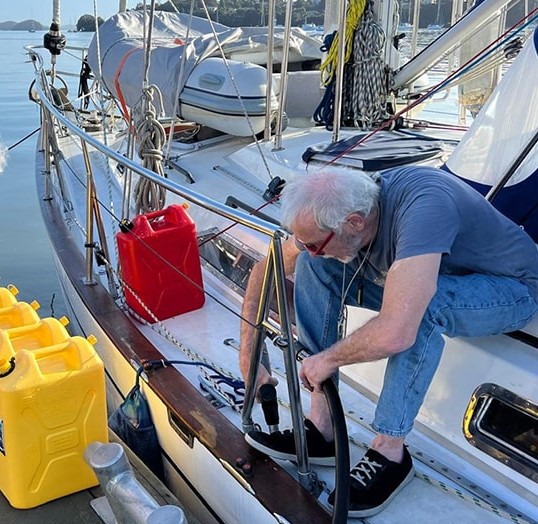
Coming into the anchoring area it was dark. There were a couple of LPG transport ships (huge by comparison to our boat) and at night hard to make out if they were buildings on land or ships in the water. Even though our instruments told us that they were ships. There was a small mooring field, however it was too dark to see the moorings. With Marty on helm and the rest of us up front looking to for things to avoid we settled on dropping anchor and tidying up saboteur for the night.
We had made it.
We were anlchored up outside Vuda Marina and had radio through to advise we were seeking customs clearance in the morning. Iain was also fatigued and so with our crew fast asleep, Marty and I sat in the cockpit for a while. Words cannot explain the quiet satisfaction of achieving this voyage. Grateful for our amazing boat that carried us here. Grateful for the crew that made this passage, even though it was the roughest we have ever undertaken, they made everything possible. And yes, we are all still friends.
The NZ Fiji crossing voyage had taken 8.5 days, we were deeply happy. It required grit, determination and conviction. We had done it.